Choosing a supplier is not just a price exercise. Primary air filter performance depends on the fibers, support layers, binders, and consistency of each production batch. A roll of media may look uniform, yet small differences in thickness or fiber distribution can affect pleat stability and airflow. Small details matter.
The World Health Organization’s 2022 air pollution fact sheet estimates that ambient and household air pollution together are associated with about 6.7 million premature deaths each year. This figure is not a measure of filter demand, but it highlights why dependable filtration materials matter. For buyers comparing Wholesale Primary Air Filter Raw Material suppliers, health concerns should be translated into verifiable technical requirements—not vague performance claims. ASHRAE Standard 52.2 describes a method for testing particle-removal efficiency, while ISO 16890 classifies air filters by their measured performance against particle-size ranges. These references help buyers ask more precise questions about test methods and product suitability.
This Top 10 guide introduces suppliers serving different needs, from synthetic and glass-fiber media to supporting materials. It considers product range, documentation, manufacturing capability, and communication. A ranking cannot settle every question. Specifications, lead times, and quality controls can change, and one source rarely fits every application. Ask for current test reports, batch records, and samples before committing to volume orders. Then compare results under the same conditions. That step takes time. It is still easy to overlook.

Primary air filters are built from materials that each perform a specific job. Filter media, often made from synthetic fibers or cellulose, captures dust while allowing air to pass. Fiber thickness, layering, and density affect both particle retention and airflow. A dense sheet may catch more fine dust, but it can also increase resistance. That trade-off matters in everyday ventilation systems.
Support materials keep the media stable. A wire mesh or formed grid helps prevent the filter from collapsing under airflow. Adhesive secures pleats and edges, while a frame made from board, plastic, or metal holds the assembly in place. A perimeter gasket reduces gaps between the filter and its housing. Small details matter. When comparing wholesale raw materials, check thickness, dimensions, bonding consistency, and performance records across batches. Ask how samples were tested and under what conditions. Supplier specifications are useful, but they do not replace evaluation in the intended system. No single material combination suits every building; that is easy to overlook. A practical choice balances airflow, dust-loading needs, handling, and replacement frequency.

Representative fiber-diameter midpoints for common filter media. Fiber sizes vary by grade and manufacturing process; this is a material comparison, not a supplier ranking.
Roles: Fine glass and meltblown polypropylene fibers capture smaller particles; spunbond polymers and cellulose provide structural or coarse filtration media. Nylon, acrylic, viscose, and cotton fibers are used in selected filter constructions.
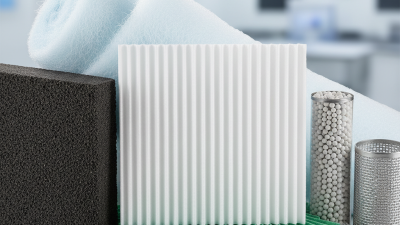
Primary air-filter media is often made from polyester, polypropylene, glass fiber, or blended fibers. Polyester is popular because it is lightweight, resists moisture, and can be formed into a stable web. Polypropylene is also light and useful where low weight matters. Glass fiber can capture fine particles, but its handling and construction require careful control. Details matter. Fiber diameter, web density, and pleat spacing affect airflow and dust-holding capacity. A thick-looking sheet is not automatically a better filter.
Other materials support the media. Expanded metal, plastic mesh, or wire grids can help maintain shape, while cardboard or metal frames hold the filter in place. Adhesives and edge sealants keep air from bypassing the media. Their compatibility matters, especially when filters face humidity or temperature changes. In procurement, ask suppliers for material specifications and test data, not just a sample roll. Real dust varies, and laboratory results cannot describe every site. I would avoid assuming two visually similar materials perform alike; small differences in fiber bonding may change pressure drop. Fit matters. A careful trial in the intended housing can reveal problems a datasheet misses.
Wholesale suppliers serve air filter manufacturers by turning raw-material sourcing into a more predictable production process. They may supply synthetic nonwoven media, wire mesh, adhesive, separators, and frame materials in production-ready quantities. Reliable partners confirm roll widths, thickness ranges, packaging, and expected delivery dates before orders leave the warehouse. These details matter when a line is calibrated for a particular media weight or pleat depth.
Suppliers also help manufacturers manage changing demand. They can hold agreed inventory, arrange repeat shipments, and flag specification changes that could affect assembly. A useful supplier shares clear product data and lot information, so production teams can check incoming materials against their requirements. Still, forecasts are never perfect. A delayed shipment or inconsistent roll can disrupt schedules, even when the price looked attractive. Buyers should review samples and confirm tolerances before scaling an order.
Tips: Request a sample roll and compare it with your current material. Check the core size, roll width, surface condition, and packaging after delivery. Keep written specifications for each order, and ask how the supplier handles substitutions. Small checks help. Don’t assume two similar-looking media grades will perform the same in a finished filter.
| Wholesale Supplier Category | Material Supplied | Common Supply Forms | Relevant Specifications | How Wholesale Suppliers Serve Filter Manufacturers |
|---|---|---|---|---|
| Synthetic nonwoven media suppliers | Polyester or polypropylene fiber media for panel and pleated filters | Jumbo rolls, slit rolls, and cut sheets | Basis weight, thickness, roll width, air permeability, and filtration performance; values vary by grade and intended application | Provide consistent roll lots, custom slitting, technical data sheets, and repeat-order supply for converting and pleating lines |
| Glass-fiber media suppliers | Fine glass-fiber filter media used in applications requiring higher particle capture than basic coarse prefiltration | Roll goods, sheets, and specialty media packs | Fiber structure, thickness, resistance to airflow, efficiency classification, and handling requirements; performance is grade-specific | Supply controlled grades, packaging that protects delicate media, and documentation for material identification and process control |
| Open-cell foam suppliers | Flexible polyurethane foam used in washable or reusable coarse-filter designs | Sheets, rolls, and die-cut blanks | Thickness, density, pore structure, compression behavior, and dimensional tolerance | Offer consistent foam blocks or sheets, conversion to specified sizes, and material options suitable for the filter’s cleaning and use conditions |
| Wire-mesh suppliers | Metal mesh used as a support, protective layer, or reusable screening element | Rolls, sheets, and cut-to-size mesh | Wire diameter, aperture, open area, weave, alloy, and corrosion resistance | Provide specified mesh openings, cut lengths, and material certificates when requested to support repeatable assembly |
| Expanded-metal suppliers | Expanded metal used for media support and structural reinforcement | Coils, sheets, and flattened or raised mesh panels | Strand width, thickness, opening size, sheet dimensions, and coating or base metal | Supply standard or made-to-order panels, shear material to size, and coordinate delivery with filter-frame production schedules |
| Galvanized and coated steel suppliers | Sheet metal and strip for frames, retainers, and supporting components | Coils, slit coils, sheets, and pre-cut blanks | Thickness, width, coating type, surface condition, and dimensional tolerance | Offer coil slitting, blanking, and scheduled replenishment for manufacturers forming metal components in-house |
| Aluminum suppliers | Aluminum sheet, strip, or extrusions for lightweight frames and support parts | Coils, sheets, profiles, and cut lengths | Alloy and temper, thickness, profile dimensions, finish, and tolerance | Match stock forms to fabrication needs and provide cut lengths or profiles to reduce in-house material handling |
| Corrugated board suppliers | Paperboard and corrugated board for disposable filter frames and separators | Sheets, rolls, and die-cut blanks | Board grade, caliper, flute type, moisture resistance, and crush strength | Supply board suited to the converting process, prepare blanks, and help maintain dependable packaging and production schedules |
| Hot-melt adhesive suppliers | Thermoplastic adhesive for bonding media to frames or joining filter components | Pellets, blocks, pillows, or cartridges, depending on application | Application temperature, open time, viscosity, set time, and substrate compatibility | Recommend compatible adhesive grades, provide handling and safety documentation, and supply packaging suited to production equipment |
| Sealant and gasket-material suppliers | Polyurethane, rubber, or other compatible sealing materials for perimeter seals and joints | Liquid or two-part formulations, foam strips, sheets, and pre-cut gaskets | Cure profile, hardness, compression behavior, dimensions, and compatibility with adjoining materials | Provide material options and cut-to-size components to help manufacturers achieve consistent sealing and assembly |
Specifications are representative purchasing considerations, not universal product values. Exact properties and suitability depend on the material grade, filter design, and applicable test requirements.
When evaluating wholesale primary air filter raw material suppliers, look beyond price. Check whether the supplier can provide consistent fiber composition, thickness, basis weight, and airflow data. A low quote means little if one roll feels noticeably denser than the next. Ask for recent test reports and confirm which methods were used. Small checks matter.
For nonwoven media, inspect samples under steady lighting and compare the surface, edges, and roll winding. Ask how production batches are identified and whether retained samples are available if a quality issue appears. A sample roll should match the written specification. Do not rely on a single attractive sample; request material from more than one batch when possible. This takes time, but can reveal variation early.
Evaluate delivery reliability, minimum order quantities, packaging, and how quickly technical questions receive clear answers. Request written specifications, change notifications, and traceability details for each shipment. Delivery promises should be realistic, especially during seasonal demand. No scorecard is perfect. I would still leave room for judgment: some useful details only become clear after repeated orders and careful incoming inspection.
Wholesale primary air filter raw material suppliers affect product consistency, airflow, and service life. Buyers commonly source nonwoven filter media, support mesh, frames, and bonding materials. Compare material specifications carefully, including thickness, basis weight, and pressure drop. Ask suppliers how they test each property and whether results follow a consistent method. A detailed datasheet helps, but it cannot replace checking a production sample.
Evaluate suppliers on more than price. Request samples from different production lots and compare them under the same conditions. Confirm minimum order quantities, lead times, packaging, and available batch records before placing a large order. One overlooked detail is how media performs after cutting or pleating; a flat sample may not show every issue. Ask about tolerances and test a completed filter in your own application. Supplier claims should be supported by clear records, not just confident sales language.
Tips: Keep a written comparison sheet. Record specifications, sample results, and delivery dates. Small differences matter. Recheck performance when materials or production conditions change.