Choosing reliable Plastic Penal Air Filter Manufacturers requires more than comparing prices or glossy product photos. These suppliers influence indoor air quality, equipment protection, maintenance costs, and workplace comfort. A well-built plastic panel air filter should fit securely, resist moisture, and maintain stable airflow during demanding operation. Small details matter, such as frame rigidity, pleat spacing, gasket quality, and the filter’s response to repeated handling.
This guide introduces seven manufacturers serving different markets worldwide. Each company is considered through practical factors, including manufacturing experience, material consistency, filtration performance, testing procedures, customization capacity, and after-sales support. Certifications can provide useful evidence, but they should not replace careful product evaluation. Buyers should request technical datasheets, efficiency results, dimensions, pressure-drop data, and sample units before making a large purchase.
The strongest manufacturers usually explain their processes clearly. They can discuss polypropylene or ABS frames, synthetic media, galvanized support screens, and suitable operating conditions without vague claims. Some also provide filters for HVAC units, cleanrooms, commercial buildings, and industrial ventilation systems. However, no supplier is perfect for every application. A company with excellent high-volume production may offer fewer custom options. Another may provide flexible service but have limited regional distribution.
That difference matters. Real performance depends on the installation, replacement schedule, dust load, and local environment. This overview aims to support a careful shortlist, not make an unquestionable decision. Even experienced buyers can overlook small compatibility issues. A practical comparison remains essential.
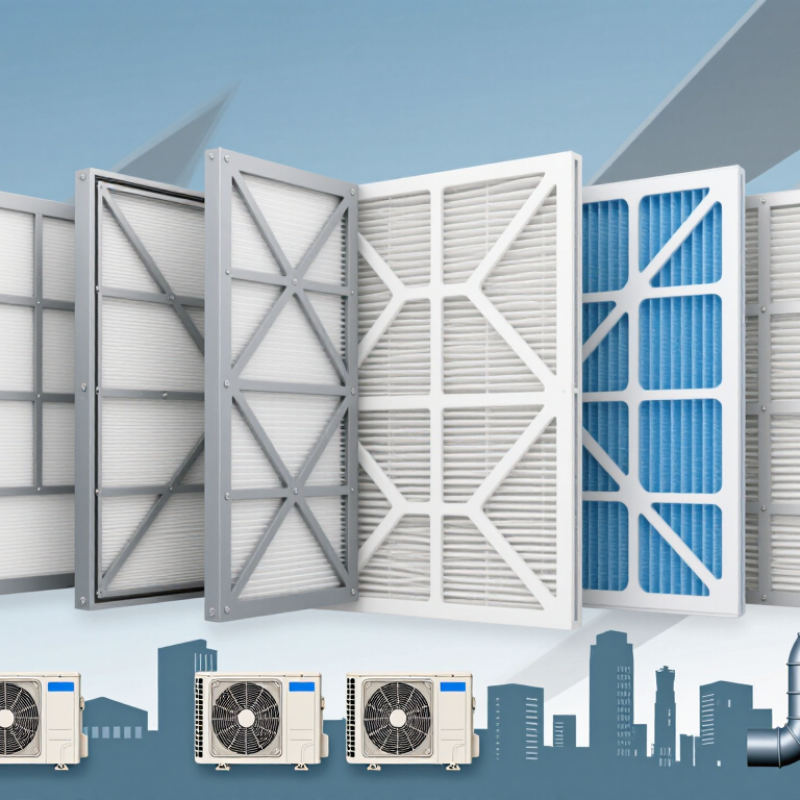
Plastic panel air filters are flat or lightly pleated filtration units with a rigid plastic frame. The frame supports the filter media and helps it fit securely inside an air-handling system. The plastic itself does not capture most particles. The synthetic fiber layer does the main work.
As air moves through the panel, larger dust particles are stopped by direct contact. Smaller particles can be captured through interception and diffusion. Some models also use an electrostatic effect to improve particle attraction. The media may look thin, but its fiber structure creates many paths for airflow. This design helps reduce dust, pollen, lint, and other airborne particles in homes, offices, workshops, and ventilation equipment.
Fit matters greatly. A small gap around the frame can let dirty air bypass the media. During inspection, check for bent corners, dark dust lines, damp areas, and rising airflow resistance. A filter that looks clean may still be loaded internally. That detail is easy to miss. Replacement timing should follow pressure readings, operating conditions, and the manufacturer’s specifications, not appearance alone. Plastic frames usually resist moisture better than paperboard frames, but they are not automatically suitable for every wet environment. Excessive resistance can also reduce system performance and increase energy use. In practice, the best filter balances particle capture, airflow, durability, and a reliable seal. No filter solves every air-quality problem.
Plastic panel air filters use a washable or reusable plastic mesh, grid, or synthetic fiber structure to capture larger airborne particles such as dust, lint, hair, and insects. As air passes through the filter, particles are retained by interception, impaction, and surface loading. Pressure drop normally increases as the filter becomes dirty, so regular cleaning helps maintain airflow.
The chart shows representative clean-filter pressure-drop values commonly used for preliminary HVAC airflow calculations. Actual performance depends on filter thickness, construction, open area, particle loading, and face velocity.
Evaluating plastic panel air filter manufacturers requires more than comparing prices. Start with verified performance data. ISO 16890 classifies filters by particulate removal efficiency, while ASHRAE 52.2 measures Minimum Efficiency Reporting Values and resistance. A reliable manufacturer should provide both test methods, airflow conditions, and pressure-drop curves. Missing details deserve scrutiny.
Material selection matters in real installations. Virgin or recycled plastic should resist moisture, corrosion, and temperature changes without warping. The frame must remain rigid during transport and replacement. Check seal compression, media bonding, and dimensional tolerances. Small gaps can bypass filtration. The U.S. Environmental Protection Agency reports that indoor pollutant levels may reach two to five times outdoor levels, making leakage control essential.
Production consistency separates capable suppliers from impressive brochures. Request batch records, raw-material traceability, laboratory calibration documents, and independent test reports. ISO 9001 certification supports process control, but it does not guarantee filter efficiency. Ask for samples from different production dates. Results can vary.
Energy performance also deserves attention. ASHRAE guidance links filter resistance with fan-energy demand, so a high-efficiency panel may create operating costs. Compare initial pressure drop at the intended airflow, not at a convenient laboratory setting. Fire behavior, disposal practices, and worker safety should be documented. One overlooked weakness remains common: manufacturers sometimes publish efficiency without showing dust-loading conditions. That is not enough evidence.
Profiles of Seven Leading Manufacturers Worldwide
Plastic panel air filter manufacturers serve homes, offices, hospitals, factories, and transport facilities. Their differences appear in frame design, filter media, testing methods, and production control. The following profiles reflect practical buying criteria rather than advertising claims.
Manufacturer One operates large automated lines in East Asia. It produces injection-molded frames and pleated synthetic media for commercial ventilation. Its strengths include consistent dimensions, fast output, and private-label flexibility. Buyers should still verify airflow data from independent testing.
Manufacturer Two focuses on European commercial buildings. Its engineers emphasize low pressure drop and documented performance under ISO 16890 testing. Recycled plastic options are available, although material traceability may vary by product series.
Manufacturer Three supplies rugged filters for dusty industrial environments. Its panel frames use reinforced corners and deeper media packs. Factory technicians often recommend pre-filtration to extend service life. That advice is useful, but operating conditions must be measured locally.
Manufacturer Four serves North American HVAC contractors. It provides standard sizes, clear installation guides, and batch identification codes. These details support maintenance records and reduce replacement errors. Some older product sheets remain vague about humidity resistance.
Manufacturer Five specializes in compact filters for retail and residential systems. Its lightweight panels simplify handling and reduce packaging volume. However, lighter construction does not always mean better durability.
Manufacturer Six develops custom panels for transport and clean production areas. It can adjust frame geometry, gasket placement, and media density. Customers should request real pressure-drop curves, not only efficiency percentages.
Manufacturer Seven combines regional factories with international distribution. Its appeal lies in stable supply and technical support across multiple markets. Still, delivery promises can change during material shortages. Careful buyers compare samples, certifications, and after-sales response before approving a long-term contract.
Choosing among leading plastic panel air filter manufacturers requires more than comparing prices. In practical procurement, frame strength, media depth, airflow resistance, and sealing quality matter daily. A rigid plastic frame resists moisture and corrosion in kitchens, laboratories, and coastal facilities. However, recycled plastic content can vary, so buyers should request material declarations and batch records. No filter is perfect.
Certification evidence separates reliable suppliers from attractive catalogues. Look for ISO 16890 or ASHRAE 52.2 test results, with clearly stated efficiency, pressure drop, and test conditions. ISO 9001 supports consistent production, but it does not prove filtration performance. For sensitive facilities, RoHS and REACH documentation may support safer material selection. Check whether reports cover the exact size and media combination ordered.
Applications should guide the final comparison. Coarse panels suit dust prefiltration in offices, workshops, and air-handling units. Higher-efficiency versions work better in hospitals, clean manufacturing areas, and commercial buildings. Yet higher efficiency usually increases resistance and energy use. That trade-off is easy to overlook.
Tips: Ask for independent test reports, not only certificates. Compare initial pressure drop at the same airflow. Inspect corner joints and gasket compression. Request samples before approving a full shipment. A small installation trial can reveal fit problems, noise, or weak seals that paperwork misses.
How to Select the Right Plastic Panel Air Filter Manufacturer
Choosing a plastic panel air filter manufacturer requires more than comparing prices. The U.S. Environmental Protection Agency reports that indoor pollutant levels can be two to five times higher than outdoor levels. Therefore, frame quality, sealing, and tested filtration performance deserve close attention. Ask for pressure-drop data at the required airflow, not only a stated efficiency percentage. A filter that looks efficient may overload a small fan.
Check whether the plastic frame resists moisture, heat, and deformation during installation. Polypropylene and ABS can perform differently under continuous temperature changes. Inspect the corner joints, gasket compression, and media bonding. Small gaps matter. They can allow unfiltered air to bypass the media. The manufacturer should provide ISO 16890 or ASHRAE 52.2 test documentation, batch traceability, and clear replacement guidance. ASHRAE 52.2 evaluates particle removal under controlled conditions, but it does not guarantee the same service life in every building.
Energy use also deserves attention. The International Energy Agency reports that buildings consume about 30% of global final energy. A filter with excessive resistance can increase fan demand and operating costs. Request airflow-versus-pressure curves from an independent laboratory when possible. Compare those results with your actual equipment. Certification alone is not enough. I would also review sample consistency after transport and installation. A practical weakness remains: many buyers trust the first laboratory sheet and never retest production batches. That assumption can become expensive.
| Rank | Manufacturer Profile | Typical Product Configuration | Relevant Performance Standard | Common Application | Key Selection Data | Recommended Verification |
|---|---|---|---|---|---|---|
| 1 | High-Volume HVAC Filter Producer | Melt-blown or synthetic media, injection-molded plastic frame, optional protective mesh, nominal depth of approximately 20–50 mm. | ISO 16890 for general ventilation filters; test reports should identify ePM1, ePM2.5, or ePM10 performance. | Commercial buildings, offices, retail facilities, and standard air-handling units. | Airflow capacity, initial pressure drop, filtration class, dimensional tolerance, and replacement availability. | Request laboratory test data, dimensional drawings, and samples tested at the intended airflow. |
| 2 | Low-Pressure-Drop Specialist | High-loft synthetic media, enlarged filtration area, rigid plastic frame, and airflow-optimized support structure. | ISO 16890 classification combined with pressure-drop testing under the purchaser's operating airflow. | Energy-conscious HVAC systems, data rooms, hospitals, and facilities with long operating hours. | Initial pressure drop, dust-holding capacity, fan energy impact, service life, and media loft stability. | Compare pressure-drop curves rather than relying only on the filtration-class label. |
| 3 | Washable and Reusable Filter Producer | Cleanable polymer mesh or molded plastic panel, corrosion-resistant construction, and drainage-friendly geometry. | Performance should be documented before and after cleaning cycles; ISO 16890 may apply where the product is classified as a general ventilation filter. | Industrial ventilation, workshops, agricultural buildings, and humid environments. | Cleaning method, cycle durability, chemical resistance, water drainage, UV resistance, and pressure-drop recovery. | Review cleaning instructions and require test results after repeated washing or compressed-air cleaning. |
| 4 | Cleanroom and Fine-Filtration Supplier | Fine synthetic or glass-fiber media in a plastic or plastic-composite frame; may include mini-pleat construction. | EN 1822 or ISO 29463 for EPA, HEPA, and ULPA filters where applicable; general panel filters should not be marketed as HEPA without the required test evidence. | Pharmaceutical areas, laboratories, electronics manufacturing, and controlled environments. | MPPS efficiency, scan-test results, seal integrity, particle leakage, gasket design, and installation orientation. | Obtain an individual or batch test certificate and verify the required leakage and sealing class. |
| 5 | Food, Beverage, and Hygienic-Design Producer | Smooth, non-shedding plastic frame, moisture-resistant media, rounded edges, and materials suitable for frequent sanitation. | ISO 16890 where relevant; material and hygiene documentation should be evaluated separately from filtration efficiency. | Food processing rooms, beverage plants, commercial kitchens, and wash-down zones. | Moisture resistance, cleanability, odor control, seal materials, migration documentation, and corrosion resistance. | Request material declarations, chemical-compatibility data, and validation under the site's sanitation procedure. |
| 6 | Custom-Dimension and OEM Manufacturer | Made-to-order plastic frames, non-standard dimensions, custom gasket positions, private-label packaging, and application-specific media. | The applicable ISO 16890, EN 1822, or ISO 29463 test method should be stated for each product configuration. | Replacement projects, packaged air conditioners, compact air-handling units, and export equipment. | Tooling cost, minimum order quantity, dimensional repeatability, lead time, packaging, and change-control procedures. | Approve a production sample and inspect frame dimensions, gasket compression, airflow direction, and labeling before mass production. |
| 7 | Sustainable-Materials and Circularity-Focused Producer | Recycled-content plastic frame, recyclable synthetic media where available, reduced packaging, and documented material composition. | Filtration performance should still be demonstrated using the applicable ISO 16890 or other relevant standard. | Green-building projects, public facilities, corporate sustainability programs, and large replacement contracts. | Recycled content, recyclability, product life, transport emissions, packaging weight, and disposal requirements. | Ask for a material declaration, recycled-content evidence, environmental product documentation, and end-of-life guidance. |